
What is the Foreign Technical Internship System?
In developing regions, there is a need to train their own people to acquire the skills, technology, and knowledge of developed countries in order to develop human resources who can play a leading role in their country’s economic development and industrial promotion.
The Foreign Technical Internship System was established in 1993 to meet the needs of developing regions, while at the same time fulfilling the role of a developed country and aiming for development in harmony with the international community.
Through the technical training for up to five years (limited to excellent companies under an excellent supervisory organization) for young people in developing regions, the program aims to transfer the skills, technology, and knowledge cultivated in Japan to developing regions, thereby contributing to the “human resource development” that bears the economic development of their countries and to the promotion of international cooperation.

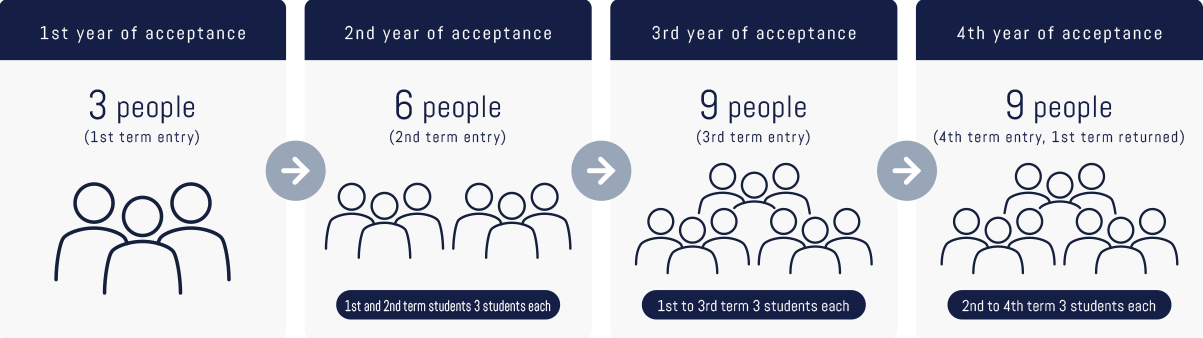
*The number of full-time employees does not include technical intern trainees (No. 1, No. 2, and No. 3).
*For nursing care occupations, “full-time employees are limited to those whose main job is nursing care. In addition, if the recipient company is small (with less than 30 full-time employees), the maximum number of recipients per year is limited to 10% of the number of full-time employees.
Advantages of Accepting Foreign Technical Intern Trainees

Occupations and scope of work covered by technical internship
156 tasks in 85 occupations, including food, construction, welding, plastic molding, painting, factory sheet metal, and ironwork.
In light of the increasing number of multi-skilled workers and the diversification of work in the manufacturing industry, the Basic Policy for the Operation of the Technical Training System Promotion Project (officially announced by the Minister of Health, Labor and Welfare) defines the scope of the job categories and tasks for technical training as “essential work,” “related work,” and “peripheral work” for each job.
-
Required work
At least 50% of the total training time: Work that must be performed in order to acquire skills, etc. -
Related work
Less than 50% of the total training time: Work that contributes directly or indirectly to the improvement of skills, etc. in the essential work. -
Peripheral work
30% or less of the total training hours: Work that does not directly or indirectly contribute to the improvement of skills, etc. in the essential tasks.