What is a Specified Technical Visa?
Currently, Japanese industries are facing a labor shortage, and each industry is trying to improve the working environment and increase business efficiency by introducing AI and other technologies to solve the labor shortage. However, in some industries, it is already clear that domestic human resources alone are not enough.
In order to accept human resources from overseas, a “Specified Technical Visa” is required for such industries. In order to obtain a Specified Technical Visa, you must pass the Specified Technical Skills Evaluation Test and the Japanese language test, and the other required documents are complicated, so it takes a lot of effort to apply for it on your own.
Leave the time- and labor-intensive work of preparing the application documents and procedures to us!
Difference from Technical Intern Training
The “technical internship” visa is a training program. After the period of training is over, the trainee returns to his/her home country to engage in work that makes use of the skills and techniques he/she has acquired and contributes to the benefit of his/her home country.
On the other hand, the “Specified Technical Skills” visa was established to alleviate labor shortages, so it is a work-related visa.
There are differences in terms of duration of stay, bringing family members, and whether or not simple labor is allowed.
Advantages of Specified Technical Visa
If you obtain a Specified Technical Skills I visa, you can stay in Japan for a limited period of five years.
If you are able to obtain a Tokutei Gijutsu (Designated Skill) No. 2 visa, you will be able to stay in Japan for an unlimited period of time, and you will also be able to invite your spouse or children in your home country to stay in Japan with you.
Furthermore, if the period of stay in Japan required for the application is met, it is possible to apply for a permanent residence visa.

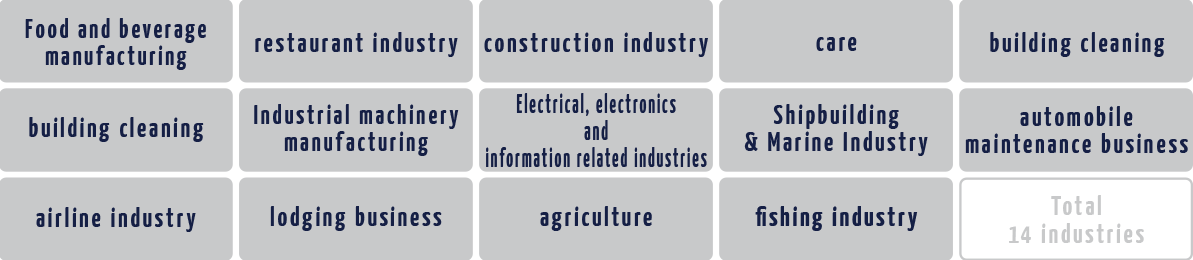
What is a specific industrial field?
Specified industrial fields are those in which foreign nationals with specified skills are allowed to work.
There are a total of 14 industrial fields, all of which are essential to our daily lives.
In these 14 fields, efforts to secure human resources in Japan are already underway, but even so, a long-term shortage of manpower is expected, so it has been decided to seek the help of foreign human resources. The fields that have been designated as specific industrial fields are as follows.